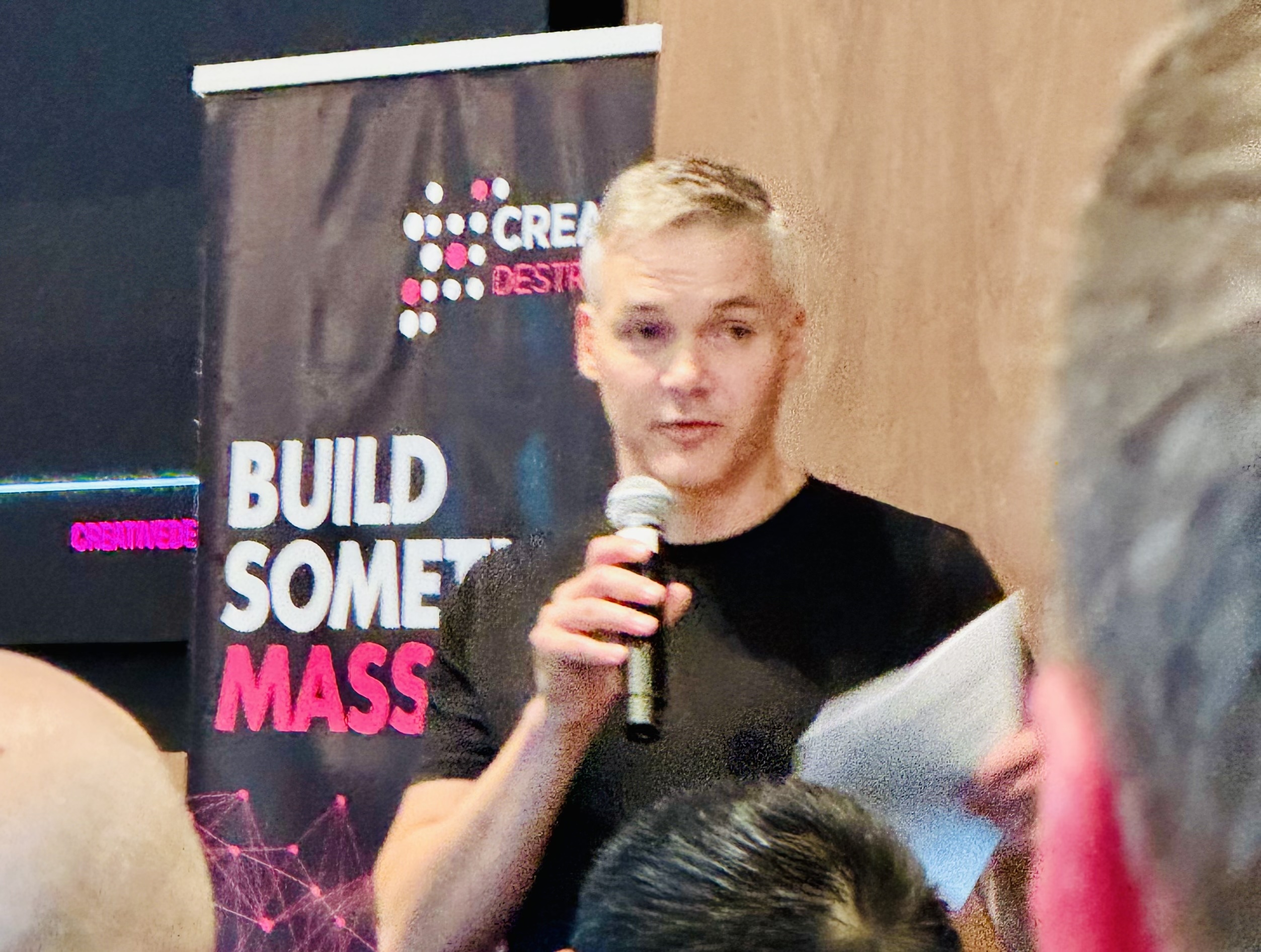
On the second day of Seattle Space Week, CEO Andy Lapsa surprised an audience of 300 Washington state space industry pros with an impassioned rant against wealth taxes. Lapsa said that he might not have founded Stoke Space if a wealth tax like California’s proposed billionaire tax had been on the books in Washington state.
The speech received a standing ovation.
A partial transcript follows.
I’ll be straight up honest with you. I’m not sure we would. Not sure we’d make the same decision.
So here we go. The first thing we need is an education system that prepares students to be productive members of society. We don’t have time here, and it’s not the place anyway. Having raised two kids through the Seattle District, I can attest, with overwhelming conviction, that the Seattle Public Schools is a failed institution, with perverse motives and corruption embedded throughout. That breaks my heart. Our children cannot be used as pawns of a political agenda. Our public schooling, of which I am a product, is an essential pillar of our national security. And at least in Seattle, it needs a hard reset.
Second, we need jobs with upward mobility, so that students have a place to go, a place to continue learning when they graduate. Our public narrative and the policies that follow are actively chasing those away. In some cases, this seems intentional. But in others, it may not be.
So let me give you an example as a precautionary tale. The idea of a wealth tax is popularized in California, and, to some extent, locally as well. These are paper, these are taxes on paper gains in the stock market, on private company holdings. But before those gains are realized—in other words, it’s a tax on risk capital. It’s a tax on risk taking. And here’s the reason why that’s a problem.
First of all, it shifts an investors’ calculation of how to allocate capital against risk, and it pushes more money under the mattress. Things like bonds and money markets. That’s where the money goes. It doesn’t get out to venture capital. It doesn’t go to people like you or me who are trying to start a company from nothing. It takes that money out of the stock market. In other words, it cuts off the flow—flow down economics.
Second, it makes pursuing a startup much more uncertain for ordinary people. and actually reinforces the wealth divide. It doesn’t bridge it.
So I’m gonna use my own personal story. And frankly, I’m a little nervous to tell, and I’ve never told it before, but I’m gonna use it to paint this picture. I’m doing it because I think this line of policy is one of the most destructive proposals possible for the American Dream. It’s one of the most destructive policy proposals you can think of to close the wealth divide. And it attacks the essence of the great democratic experiment that we’re all part of.
I am the son of a legal immigrant. He grew up in a post war refugee camp. Waited 12 years to get his ticket, his golden ticket, these United States. And he came in here, not speaking, a lick of English. Dropped into middle school with no special programs. He just had to figure it out. And he did. He was a university researcher. He gave me the incredible privilege and opportunity to grow up in middle class America.
And even so, my mom had to work a minimum wage job to get me and my two siblings through college. When I graduated from college undergrad, between my wife and I, we were about $200,000 in debt. I made the decision to go to grad school. The first words out of my mom’s mouth were, “I’m not paying.” [Audience laughter.] Not “Congrats, honey.” No, “I’m not paying.” I’ll never forget it.
But that’s what she had put herself through to get me through college. When I was in grad school, my now wife worked two jobs in healthcare. She worked a day job, and she worked a night job. I worked on my dissertation. We saw each other before bed. We woke up at 5:00 a.m. and we did it all over again.
When we moved out here [to Washington], we worked similarly hard to pay off our debt and start a family in the city. You know, as well as I do, it’s hard to do. We did that for 10 more years. We did successfully pay off our debt. We even saved a small nest egg. Small. And that came a decision to leave my well-paying, upward trajectory job, give up my salary, and start something crazy: go up against two of the biggest titans in the history of the world.
That’s a tough decision, if you can’t tell. It was easily the hardest decision I’ve ever made. Most of my friends screamed that this is irrational and stupid. And I only did it after deriving clear bounds on finances and time. If I couldn’t get on a track to pay myself some form of living wage within nine months, that was gonna be it. Good try. Nice scratch of the itch, and nothing more.
And in those nine months, we were able to win a few small business grants, and after that, we were able to start finding a small amount of success with angel investors, two of whom are in the room today, and to whom I am forever thankful. Until eventually we started gaining some traction with proper equity financing.
If I recall, it wasn’t until about 15 months later that I paid myself half of what I made at my old job. That’s 15 months of hundreds of people telling you no. Telling you that your idea is dumb. “Why would you ever do that? Now you’ll never be able to make it.” And sometimes, those messages are delivered with personal insults. If you’re a founder, you struggle to raise money, so you probably know what I’m talking about. And the nest egg that I mentioned before was gone.
So why is any of that relevant? Because when you start a company, you file papers that assign you 100% ownership of your company. In reality, you split that with a co founder, to set aside some for an employee equity pool. But for the sake of the example, let’s say you own 100% of the company. And to be clear, when you file those papers, that’s 100% of nothing.
Then you finally close some financing, and the valuation of the company is formally established. Let’s say you would raise $10 million, and you sell 25% of your company to do it. That means your company is worth $40 million overnight. And you are worth $30 million, on paper. The founder doesn’t get a dime on that day. Right? They’re no more liquid than they were the day before.
So as the company keeps going, that same effect keeps happening. The valuation grows. The value of your ownership grows. But usually, a founder can’t get liquidity until the very end. They’re down in the stack. Same with the employees. So if that paper gain comes with a tax bill, it’s lights out for the founder. Raising money is an incredibly hard thing to do. And even if you’re successful, investors want their money to go to the company, not to pay the founder’s personal taxes.
There have been various proposals to address this, like government-backed loans, or deferred payment plans, but I assure you, as someone who worked hard to scratch and claw out of debt, there’s no way I would take a new personal liability of a size that dwarfed my wildest dreams for wealth creation.
Put simply, the subject to the proposed wealth tax in California, Stoke would not exist. And furthermore, I suspect this would be true for many others.
In fact, if you look at the top 14 companies, by market cap, today, in the U.S., eight of them have founders who’ve come from modest means. These are immigrants, children born of immigrants. Companies started as small family businesses. They’re college dropouts, nothing more than dreams and grit. Jensen Huang, head of NVIDIA, the biggest company in the world, spent his days after school cleaning toilets with his mother. The wealth tax on unrealized capital gains would kill them all. before they’re ever even allowed to start. And it would have removed capital from the ecosystem that gives us a chance.
Here’s the irony. You make it so that the only people who can afford to start a company are the people who are already rich.
The United States is a country of risk takers. We’re change agents. We’re a beautifully diverse group of people who see the world the way it is, envision a better way of doing things, then have the gumption to do something about it. Our system of risk capital is unlike any other in the world, and that’s why companies move to the United States to grow and scale. That’s why it doesn’t happen anywhere else in the world.
Risk capital gives everyday people, like me and you a road to the top. Not the other way around.
So risk capital combined with a world class education system, which we do have in the United States, and unmatched American grit, is the reason our country and our region is successful. Those are the ingredients.
That’s why we’re all at the top of the world order, even though other countries have 10 times more people.
So what does it take for the next stope to build in Washington? It takes you, it takes me, takes our citizens thinking about the consequences and policies that are being proposed. It takes all of us looking beyond the headlines and our feeds.
This is important. Look beyond the headlines and your feeds, do the work, and instead think critically about where those headlines came from. and why. It means if we start realizing that political extremism does harm to America, that it comes with great benefit to our adversaries.
And it should come as no surprise to you that that divisiveness is stoked by those same adversaries who have access to your feed in ways that have never been true before. Means that we start appreciating the virtues of hard work again, creativity, independence, liberty, democracy, freedom, and yes, capitalism. It means we celebrate job creation, not vilify it.
It takes our public policymakers to fight for entrepreneurs and businesses, to come and stay in Washington State. Just like South Carolina, and Texas, and Florida, and Ohio, and Idaho, and Illinois, all of whom I have received emails from this week or last week to try to get Stoke [Space] to open up shop there. But I’ve never received the same from Washington State.
Instead, we’re in a dangerous cycle of rhetoric, and we’re inventing obstacles for the sake of momentary headlines, on both sides of the aisle. It’s important not to forget that we as Americans have more in common than we have as differences.
We enjoy incredible freedom. We can’t take it for granted. These are the reasons the United States of America rose to be the greatest country in the history of the world.
These are reasons we have incredible luxury of hurling insults at our president, if that’s what we choose to do. Do not underestimate that value. These are the reasons why we can change our public policy if it’s not working for us. These are the reasons why my dad has refused to set foot in another country for 58 years. He will not leave the great United States of America. And these are the reasons why I stubbornly claim to the hope that Washington State will come around, and the next Stoke Space decides here is their place. Thank you so much.
—Andy Lapsa, CEO of Stoke Space, at “Manufacturing the Future in the PNW: Space, Defense and Robotics” on Sept. 28, 2026 during Seattle Space Week 2026. The speech was also covered by Geekwire, which added that “Washington does not tax unrealized gains.”

