Ever heard of The Great Filter?

It’s a story that potentially explains why Earth hasn’t yet been contacted by alien life. There might be a very difficult obstacle every intelligent life form eventually faces, an obstacle greater than all the ones before it, that almost no species surmounts. This obstacle permanently extinguishes (filters) almost all life forms. If the Great Filter exists, it’s an evolutionary challenge humans could face with extremely low probability of success.

There’s an excellent article discussing The Great Filter (and other responses to Fermi’s Paradox) on the blog Wait But Why. And the authors note that, if the Great Filter exists, we don’t know whether we’ve already encountered it or not. WBW writes:

Therefore, say Group 1 explanations, it must be that there are no super-advanced civilizations. And since the math suggests that there are thousands of them just in our own galaxy, something else must be going on.

This something else is called The Great Filter.

The Great Filter theory says that at some point from pre-life to Type III intelligence, there’s a wall that all or nearly all attempts at life hit. There’s some stage in that long evolutionary process that is extremely unlikely or impossible for life to get beyond. That stage is The Great Filter.

For example, regardless of what one thinks of the possibility of anthropogenic climate change in the short term (the next 200 years), the fact is that Earth’s climate WILL change in the long term (in the next 200,000 years). Drastically. You could imagine how dramatic and geologically quick swings in climate could challenge a species. There are multiple phyla on earth whose species span extreme climates, like cyanobacteria and tardigrades.

How does this relate to moving off-world?

Finding ways to adapt to different living conditions is a useful step toward passing the Great Filter. Let’s diversify our real estate strategy. Hedge our bets.
An important initial step in securing an off-world future is starting and scaling manufacturing in space.

Several companies are already working on the problem of mining in space, to capture the rich deposits of gold and other metals embedded in asteroids. But most likely those metals will be brought back to Earth to be worked. We’ll still need to figure out how to process raw materials and build things without the benefit of gravity and, eventually, without bright starlight. Otherwise, any vessel we permanently eject from Earth, no matter how well provisioned, will ultimately break down and kill its inhabitants.

But how to get started? I think we start simply. Do something that draws attention and gets people thinking about doing business from space. Take a straightforward, known manufacturing process, and reproduce it in space.

Like T-shirts. Truck all the fabric, thread, tags, and equipment into orbit, assemble a batch of shirts there, and cart it back down. Label it “Made in Space” and charge hundreds of dollars for it.

Would you buy a shirt simply because it was made in space? I would.

“Catastrophic climate change forces humanity to send astronauts through a wormhole to find new, unfucked agricultural resources for Earthlings.” That’s the premise for Christopher Nolan’s (Memento, Batman Begins) 2014 film Interstellar. It’s exciting to imagine movie audiences seriously starting to think about the potential for exploring cosmic opportunities outside of Earth.

Only problem is…we ain’t found no wormhole yet. And space is big. So big that just getting to our Sun’s nearest star, as fast as humans can make spacecraft go, would take 50,000 years. As Neil deGrasse Tyson so elegantly put it, “The distances of space are incommensurate with the longevity of our biological form.” This probably means we’ll need an interim strategy before colonizing a brand new star system.

Wormhole or no, it’d be nice to start working on an exit strategy before we’re staring extinction directly in the face.

“Interstellar” premieres in November.

One reason to plan on colonizing elsewhere before our 5 billion years are up: asteroid collisions.

Neil deGrasse Tyson discussed the threat of asteroid impact on StarTalk Radio (emphasis ours):

We know the size of an asteroid that would do very bad things. It’s about a kilometer across, little more than half a mile across. That size asteroid would disrupt civilization. It wouldn’t leave us extinct, but it would disrupt the food chain, transportation channels, things that we rely on for modern living.

…And then at a ten-kilometer size, you’ve got about an extinction level asteroid.

…In the old days, we thought it would just leave a crater, and [you’d be affected only] if you were unlucky enough to be where the crater hit…but we learned that the stuff it thrusts into the atmosphere blocks the sun, cloaks the earth, knocks out the base of the food chain — because photosynthesis can’t unfold — and a wave of extinction percolates across the tree of life.

Check out NASA’s map of Potentially Hazardous Asteroids or dig into more data at the Near Earth Object program. You may have previously heard NdGT describe the impact risk from Apophis, a 0.325 kilometer-sized object, whose risk of impact was of concern in 2013 but later downgraded.

“In all this vastness, there is no hint that help will come from elsewhere to save us from ourselves.”

Jenova 7 – “Inner Space (feat. Hugo Kant)”

“Outer Space” — created with footage from NASA Voyager and Cassini

Comedy producer and writer Seth MacFarlane (famous for Family Guy) is planning to help return the cult favorite PBS show Cosmos to television. Cosmos, originally hosted by Carl Sagan, will be rebooted, with Neil DeGrasse Tyson as host, on the FOX network.

The reboot of the show may help popularize interest in astrophysics and the possibilities of space travel.

Says Forbes:

MacFarlane’s path to Cosmos started with the Science & Entertainment Exchange, an organization set up by Airplane director Jerry Zucker to help Hollywood work with scientists to ensure shows like CSI are factually correct. Through the group he met the famous astrophysicist Neil DeGrasse Tyson. “He said he was going to host Cosmos, and he was trying to sell the show to a cable science network,” says MacFarlane. “I said, ‘Let me take you into Fox and we’ll see what happens.’”

Ann Druyan, Sagan’s widow and the force behind the new Cosmos, says that the network has agreed to make the show using cutting-edge visual technology (the original was one of the first to use green screens) and is letting her have control over the content of the show. “Seth was already a hero in our household because of Family Guy,” says Druyan, who has two sons. “I knew he would be someone with a skeptical nature and an impatience with superstition and nonsense.”

Cosmos: A Space-Time Odyssey will debut in 2013.

snippet

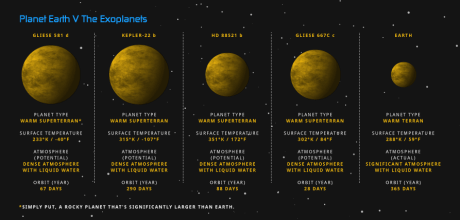
Nice post from Visually on the search for habitable planets. The one most similar to Earth is a million years’ drive away. Get packing…

Infographic: Are we alone in the universe?

Most liveable alien worlds ranked

Let’s go house shopping.

“Here’s what we can do to change the world right now. Take all that money we spend on weapons and defense each year, and instead spend it feeding, clothing, and educating the poor of the world, which it would many times over, not one human being excluded, and we can explore space: together, both inner and outer, forever, in peace.”